The 48-Hour Echo: What Your Aching Legs Are Actually Telling You
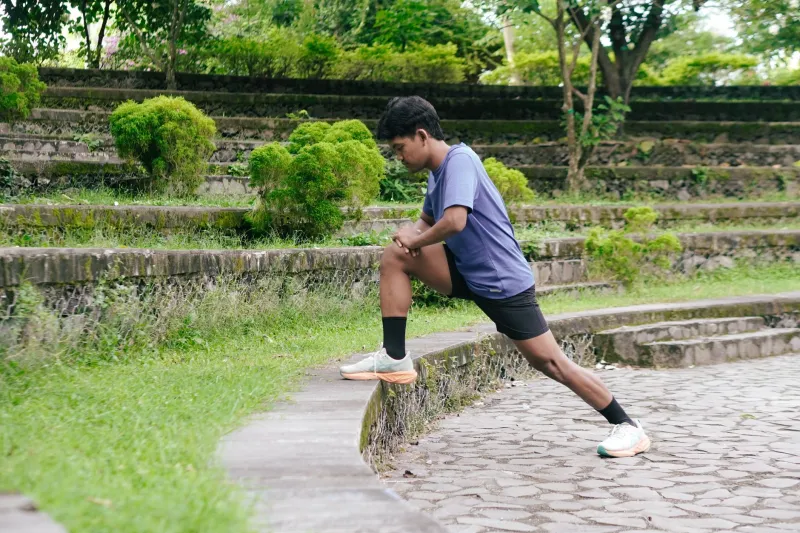
There's a particular kind of Thursday morning that only makes sense if you trained on Tuesday. You lower yourself onto the loo like a pensioner, you eye the office stairs with open suspicion, and you briefly wonder whether the lift counts as a legitimate mode of transport. Nothing is torn, nothing is swollen, but your thighs have apparently filed a formal complaint.
That's DOMS — delayed onset muscle soreness — and it's one of the most misunderstood bits of the gym. Here's what's actually going on, and how to make a sensible call about your next session.
The two-day delay, explained
DOMS isn't lactic acid. That myth has been doing the rounds since the 1980s and it still turns up in changing rooms. Lactate clears within an hour or so of training. What you're feeling 24 to 72 hours later is a mix of micro-damage to muscle fibres — especially where the muscle lengthens under load, the 'eccentric' part of a movement — plus local inflammation, and the nervous system turning up the sensitivity dial while it tidies up.
The eccentric bit is why the first session back after a break hits so hard. Lowering a dumbbell, walking down stairs, descending into a squat: all of these load the muscle while it lengthens. That's the bit that leaves a mark, and it's also the bit your body adapts to fastest.
Why day two stings more than day one
If you've ever finished a session feeling fine and then been floored 36 hours later, you're not imagining it. The damage peaks early, but the inflammatory response and the resulting sensitivity ramp up over the following day or so. It isn't a sign you did something wrong. It's a sign your body is doing the repair work it needs to do.
The practical upshot: don't judge a session by how you feel that evening. Judge it by how you feel two days later — and adjust the next one accordingly.
Soreness versus something worth worrying about
Here's the line that matters. Normal DOMS is:
- felt in the belly of the muscle, not in the joint
- symmetrical, roughly — both legs, both arms
- tender to touch but not agonising
- easing within 48 to 72 hours, and noticeably better after a warm-up
Not normal — and worth a conversation with a professional — includes:
- pain in a joint rather than the muscle
- sharp, pinpoint, or one-sided pain
- swelling you can see, or skin that's hot and red
- numbness, tingling, or a limb that feels weak in a way that doesn't ease
- pain that gets worse rather than better over 72 hours
- dark, cola-coloured urine, or a level of swelling and weakness that stops you moving normally
That last cluster is rare but serious. It's the set of symptoms that can point to rhabdomyolysis, where muscle breakdown outpaces what your kidneys can handle. If you've done an unusually brutal session — a first CrossFit class, a long downhill run, a lot of eccentric work — and you're passing dark urine, ring 111 or speak to a GP the same day. Don't wait to see if it settles.
The decision tree: train, adapt, or stop
When you're sore and a session is coming up, run this quick check.
- Can you walk up a flight of stairs without wincing? If yes, you're probably fine to train — with adjustments.
- Does a five-minute warm-up make it feel better rather than worse? If yes, that's a green light for a lighter session. If no, take the day.
- Is the soreness in the muscle belly, or in a joint or tendon? Muscle belly: adjust. Joint or tendon: back off, and get it looked at if it lasts more than a few days.
- Are you sleeping and eating normally? Soreness plus a bad night's sleep plus under-eating is a recipe for a rubbish session. Eat, sleep, then decide.
How to adjust rather than abandon
The all-or-nothing approach — either smash the session or sack it off entirely — is how people end up with a stop-start training history. Instead:
- Reduce volume first. Cut the sets by a third and see how you feel. That's usually enough.
- Drop the load, keep the pattern. Same movement, lighter weight, more reps — you're still rehearsing the skill.
- Change the stimulus. If your legs are shot, do upper body. If your pressing muscles are sore, do some easy cardio. Blood flow helps, and it doesn't have to be heroic.
- Warm up properly. Five to ten minutes of easy movement and a few ramp-up sets will tell you more about your readiness than any app.
What actually helps (and what's overrated)
- Movement. Gentle walking, cycling, swimming — anything that gets blood moving. This is the single most reliable thing you can do.
- Sleep and food. Protein and overall calories matter more than any recovery gadget. A normal meal with a decent protein source beats a supplement stack.
- Time. Most soreness resolves in 48 to 72 hours. Nothing you do will speed that up dramatically.
- Overrated: static stretching before training (doesn't prevent DOMS), ice baths (may blunt some adaptation if used routinely after strength work), and 'sucking it up' (not a recovery strategy).
The Thursday rule
If you're going to remember one thing, make it this: soreness is information, not a verdict. It's telling you that you did something new or something hard, and that your body is adapting. Train through the mild stuff with a bit of judgement, adjust the moderate stuff, and get help for anything that looks like the red flags. The stairs will forgive you by the weekend.