The Meeting-Gap Method: A Workday Strength Session That Won't Wreck Your Shirt
There is a particular kind of fitness advice that assumes your day is made of elastic. It suggests you rise at 5am, drive to a gym, complete a 45-minute session, shower, commute, and arrive at your desk looking like a wellness advert. For most people, that is not a training plan. It is a fantasy with a monthly direct debit.
The meeting-gap method starts somewhere less glamorous: the 15 minutes you already have. Not the 15 minutes you might find if you cancel something important, but the real gap between a call ending and the school pick-up, or between finishing work and starting dinner. The aim is not to pretend a short session is the same as a long one. The aim is to make strength and mobility fit inside a normal UK workday without turning your shirt into a warning sign.
Low-sweat does not mean low-effort
First, a sensible caveat: some people sweat heavily doing very little. Others can do a decent strength session in a cool room and stay presentable. The no-shower workout is not a promise that you will remain dry. It is a way of choosing exercises, pace and kit so that the session is unlikely to push you past the point of needing a full wash.
The trick is to lower the sweat threshold without lowering the standard. You do that by using controlled reps, shorter ranges where needed, and tension rather than speed. A slow split squat with a pause at the bottom is hard work for your legs, but it does not spike your heart rate like a set of burpees. A band row done with a two-second squeeze is genuinely useful for your upper back, and it will not leave you gasping into your laptop microphone.
This is also a good fit for the colder months. In November 2026, with the clocks already changed and the evening air carrying that damp UK chill, a short indoor session is often more appealing than heading out for a run in the dark. You are not trying to replace your main training. You are trying to avoid the all-or-nothing trap where a busy day becomes a zero day.
The 15-minute gap session
Set a timer for 15 minutes. Do a two-minute warm-up, then move through the circuit below. Keep the effort around six or seven out of ten. You should feel your muscles working, not feel like you are racing a commuter train.
Warm-up (2 minutes): march on the spot, roll your shoulders, hinge forward and back a few times, and do some gentle hip circles. Nothing heroic.
Circuit (repeat twice, resting as little as you need):
- Slow split squat, six reps each side. Hold a wall or chair if balance is an issue.
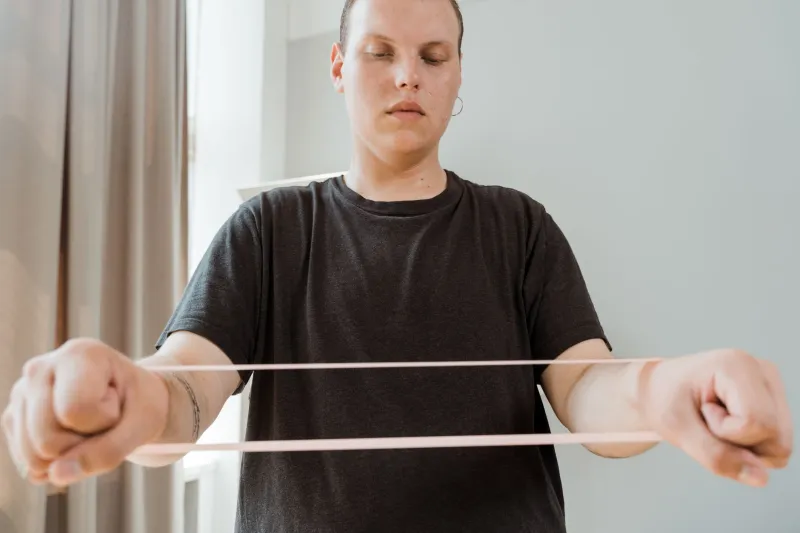
- Band row or towel row, ten reps. Pull your shoulder blades back and down, then release slowly.
- Glute bridge, ten reps with a two-second squeeze at the top.
- Incline press-up against a desk or wall, eight reps. Keep your ribs down and move at a controlled pace.
- Dead bug, six reps each side. Slow and quiet beats fast and floppy.
- Standing hip flexor stretch and hamstring sweep, thirty seconds each side.
That is it. If you have time for a third round, do it. If you have seven minutes, do one round. The session is designed to be repeatable, not impressive on paper.
Kit that actually helps
You do not need a lot. A long resistance band is the single most useful purchase here because it lets you train your back without a pull-up bar or a gym. A loop band is handy for glute work, but a tied long band will do. A microfibre towel and a pack of body wipes live in the same drawer as your charger cables and earn their place on warmer days. A spare pair of socks is a small luxury if you are going straight from the kitchen floor to a train.
What you wear matters more than most people admit. Heavy cotton holds sweat and stays damp. A breathable base layer under a jumper or shirt is a better call than a full gym kit if you are training at home in work clothes. Keep the room cool, open a window for a few minutes beforehand, and avoid doing the session immediately before a video call where you need to look composed. If you are genuinely soaked, have a shower. The no-shower workout is a tool, not a religion.
Scheduling without pretending
Most people fail at this because they schedule the session in a place that does not exist. Do not put it at 6am if you are not a morning person. Do not put it at lunchtime if your lunch is the only time you leave the building. Put it where the gap already is.
Try one of these: the ten minutes after you close your laptop before you start dinner; the gap after the school drop-off before your first meeting; or the point in the afternoon when you would otherwise scroll your phone and call it a break. Name it something bland in your calendar, like "mobility", so it does not feel like a performance. Two short sessions in a week is a real result. Three is a good week. Four is excellent, unless it makes you miserable, in which case it is not excellent.
What to track
Do not track sweat. Track control. Can you do the split squat without wobbling? Can you feel your upper back working in the row? Are you able to keep your ribs down in the press-up? Once the current circuit feels easy, add a little band tension or slow the lowering phase rather than adding a hundred extra reps. That keeps the session short and the effort useful.
The meeting-gap method will not build a powerlifter's total or prepare you for a fell race. It is not meant to. It is meant to keep strength and mobility ticking over on the days when a proper session is not realistic. For a lot of busy people, that is the difference between a sustainable habit and another abandoned plan.