The Quiet-House Session: Strength Training After the Kids Are Down
It’s just gone 9pm. The dishwasher is doing its thing, the kids are finally down, and the last work message has been answered. You’ve got maybe 40 minutes before you need to be horizontal. The sensible voice says: leave it, you’re tired. The other voice says: you’ve said that three times this week.
This is the quiet-house slot. It isn’t glamorous, it won’t show up on a fitness influencer’s feed, and it is probably the most realistic training window a lot of UK adults have. The trick isn’t turning it into a second shift. It’s making it short, repeatable and kind enough to your sleep that you actually do it again next week.
The late slot is not a character flaw
There’s a strange idea that real training happens at 6am or not at all. For anyone juggling school runs, commutes, caring responsibilities or shift work, that’s just not true. A 35-minute session at 9pm done twice a week will do more for your strength than a perfect four-day plan that lives in a notes app.
What matters is managing the edges: the set-up, the caffeine, the food, and the wind-down. Get those roughly right and evening training becomes a habit rather than a heroic one-off.
The 35-minute quiet-house session
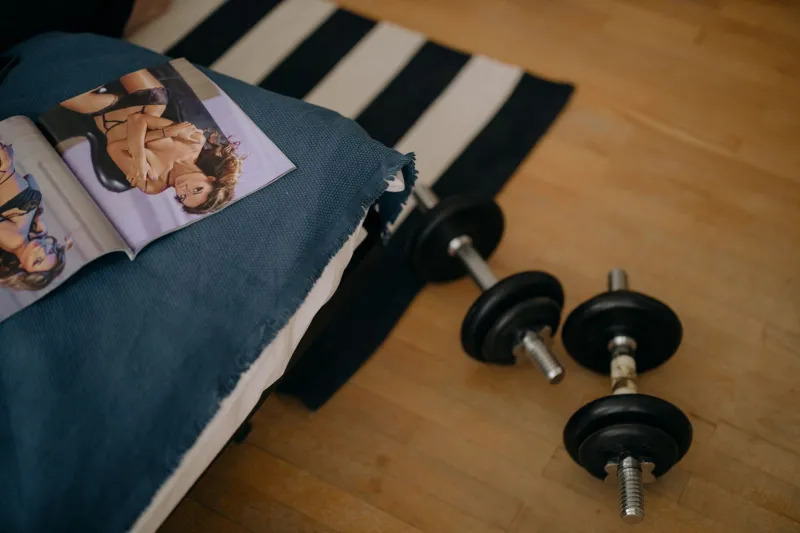
This is a straightforward full-body template. You need a pair of dumbbells, a kettlebell or a sturdy backpack, plus a chair or bench. If you train at a gym, use the same structure with machines or free weights. Keep the effort around 7 out of 10 — you should finish each set feeling like you had two or three good reps left.
Warm-up (5 minutes): march on the spot, arm circles, bodyweight squats, hip hinges, and a few slow shoulder presses. No need for a full mobility routine at this hour.
Main work (25 minutes):
- Goblet squat — 3 sets of 8–10 reps. Hold a dumbbell or kettlebell at your chest. Slow down on the way back up.
- One-arm dumbbell row — 3 sets of 8–10 reps per side. Brace a hand on the chair. Keep your back flat.
- Romanian deadlift or hip bridge — 3 sets of 8–10 reps. If you’re using dumbbells, hinge at the hips and keep the weights close to your legs. If your lower back is tired from sitting, the hip bridge is the friendlier option.
- Push-up or floor press — 3 sets of 8–12 reps. Use an incline (hands on the sofa or a sturdy box) if floor push-ups are too much tonight.
Rest 60–90 seconds between sets. Finish with a 3-minute carry — walk slowly with a weight in each hand — or a 45-second plank. Then stop. This is not the time for a finisher that leaves you wired.
Set up before the bedtime chaos
Evening sessions die in the gap between intention and kit. Sort the friction earlier: leave your clothes on the radiator, fill a water bottle at lunchtime, and put the dumbbells somewhere you can see them. If you train at a gym, pack the bag before dinner and leave it by the door.
Have a minimum version too. On nights when the house goes quiet later than expected, do 15 minutes: squats and rows, two sets each. The rule is not ‘all or nothing’. The rule is ‘never miss twice’.
Caffeine, food and the sleep handbrake
If you’re sensitive to caffeine, the cut-off is earlier than you think. A 3pm coffee can still be in your system at 9pm. Switch to decaf after lunch if you know you’re training late, or keep the session moderate and accept that a strong espresso at 8pm is a bad trade.
Food is simpler: a small snack 60–90 minutes before training works for most people. A banana and yoghurt, a slice of toast with peanut butter, or a small bowl of porridge. Don’t train starving, but don’t train on a Sunday roast either. Drink water through the evening rather than downing a litre at 9.05pm.
The wind-down that actually matters
The main sleep risk isn’t the training itself — it’s the bright screens, the adrenaline and the ‘one more set’ mentality. Finish your last hard set at least an hour before bed where possible. Dim the lights, take a warm shower, and keep the phone out of the bedroom for the first ten minutes.
If you’re finishing close to bedtime, choose the lower end of the effort range. A brisk but controlled session is less likely to leave you staring at the ceiling than a set of maximum-effort squats. A few slow breaths and a legs-up-the-wall stretch won’t hurt either.
When the session gets eaten
Some nights the house doesn’t go quiet until 10pm. Some nights you’re needed. Some nights you’re just knackered. That’s fine. The quiet-house session is a template, not a debt. Do the 15-minute version, or move it to the next evening and keep the week’s total realistic.
A simple tick on the calendar is enough tracking. Two ticks a week is a win. Four is a great week. Zero is information, not a verdict — look at what got in the way and adjust the set-up.
The quiet-house rule
The session doesn’t need to be impressive. It needs to be repeatable. Thirty-five minutes, a few dumbbells, the dishwasher humming in the background. That’s the club. No queue for the squat rack, no parking, no wondering whether you’ll get home before the kids wake up. Just a short, honest bit of strength work in the margins of a busy day.
Late is not ideal. But late and consistent beats ideal and imaginary. Put the kit out, keep the effort sensible, and let the quiet house do you a favour.