The Wheelbarrow Progression: A Paced Saturday Strength Session for Allotment Holders
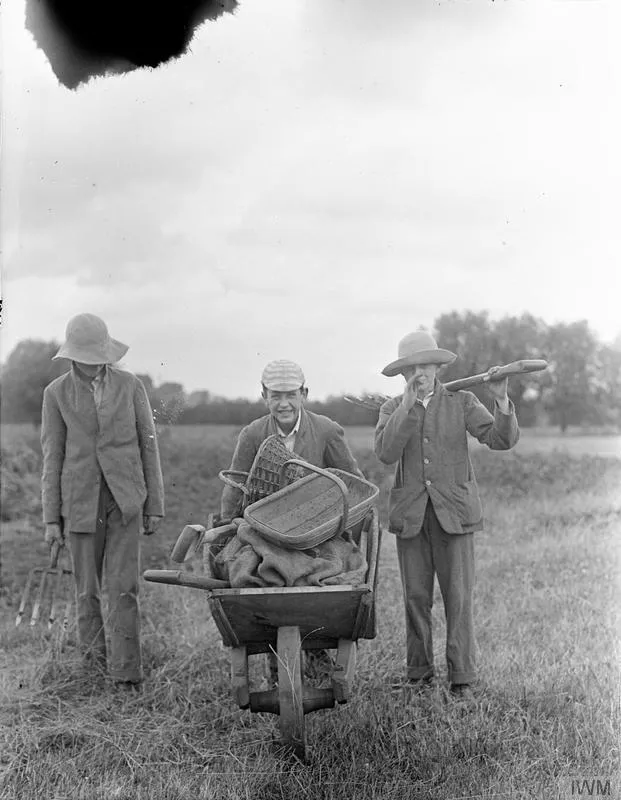
Photo: Horace Nicholls, Public domain, via Wikimedia Commons
A Saturday on the allotment has a way of turning into a full-body session without anyone calling it one. You arrive with a flask, a list and good intentions. Two hours later you have shifted half a tonne of clay, wrestled a wheelbarrow through a muddy gate and carried more water than you thought possible. The plot is not a gym, but it is close enough to one that it deserves a bit of programming.
The idea here is not to bolt a workout onto your gardening. It is to treat the jobs you already do — digging, barrowing, watering, hauling compost — as functional training, then pace them so you can still walk on Sunday. That matters more in November, when cold mornings make stiff backs stiffer and the light disappears before you have finished the list.
Why plot work counts as strength training
Most allotment tasks are loaded movements in disguise. Digging is a hinge-and-squat pattern with rotation. Barrowing is a loaded push and carry with a serious grip demand. Hauling compost bags is a deadlift with worse handles. Watering cans are farmer's carries, just with more sloshing.
That is genuinely useful training for busy people. It builds legs, trunk and grip in patterns you actually use. The catch is that plot work is repetitive and uneven. You might spend forty minutes bent over one bed, then suddenly lift a bag that is heavier than your back has prepared for. A little structure goes a long way.
The Saturday session at a glance
Think of the morning as four short blocks rather than one long grind. The timings are a guide, not a rule — adjust to the jobs on your list and how cold it is.
- Warm-up: 8 to 10 minutes near the shed
- Block one: digging or forking over, 12 to 15 minutes, then a 2 to 3 minute rest
- Block two: wheelbarrow runs, 8 to 10 minutes, then rest
- Block three: compost or manure hauling, 8 to 10 minutes, then rest
- Block four: watering can carries or smaller tidy-up jobs, 5 to 8 minutes
- Cool-down: 5 minutes of easy walking and gentle movement before you get in the car
If that looks short, good. The aim is to finish the morning feeling like you could do it again next week, not like you need a lie-down in the shed.
Warm up before you pick up the spade
Cold muscles and a cold shed are a bad combination. March on the spot for a minute, then run through a few easy movements: hip circles, ankle rocks, gentle bodyweight hinges, wall push-offs and a few slow squats to a comfortable depth. You are not stretching to impress anyone. You are waking up the joints and reminding your back what bending feels like before it meets a fork.
Keep a warm layer on until you start digging. A hat helps more than you think. If the ground is frozen or the forecast is grim, choose lighter jobs first and save the heavy lifting for when you have moved for ten minutes.
Digging: the hinge you already know
Digging is where most weekend backs get into trouble. Stand with feet wider than your hips, keep the spade close, and let your legs and hips do the work. Avoid twisting with a full load of soil. Turn your feet instead. Alternate sides every few minutes so one shoulder is not doing all the steering.
Do ten to twelve digs, then stand up, breathe and look at something other than the soil. That tiny pause is not laziness. It is how you keep the quality of the movement from falling off a cliff.
The wheelbarrow is a loaded carry
A wheelbarrow teaches you fast that volume is not the same as usefulness. Fill it less than you think, especially on uneven ground. Grip the handles, brace your middle, and push from the legs rather than yanking with your arms. Take shorter runs and rest between them.
If you are new to the plot, start with half loads and add a little more each weekend. That is progressive overload, allotment style. It also saves you from the classic November mistake of moving a whole compost heap in one morning because the sun came out.
Compost bags and the art of the sensible lift
Compost bags are awkward because the handles are rubbish and the weight sits low. Treat them like a deadlift: stand close, hinge at the hips, keep your back long, and lift with your legs. If a bag is too heavy, split it into a bucket or use a trolley. There is no prize for heroic bag-handling.
Haul for eight to ten minutes, then stop. If you have a long walk from the car park, that is part of the session too. Make two trips with lighter loads rather than one grim struggle.
Watering cans, grip and the finish line
Watering can carries are a simple way to add a bit of conditioning at the end. Fill two cans to a comfortable weight, walk ten metres, set them down, turn around and come back. Keep your shoulders relaxed and your ribs stacked over your hips. If your grip is fading, the cans are too full.
The pacing rule that saves your Sunday
Use the talk test. If you cannot speak a full sentence while digging or pushing the barrow, ease off. Take a proper break every twenty to thirty minutes, even if it is just standing with the flask. Rest is part of the session, not a failure of enthusiasm.
Set a timer on your phone for the heavy blocks. It is easy to lose track when you are focused on clearing a bed. A timer also gives you permission to stop, which is surprisingly useful.
Back care for cold mornings
Keep moving between jobs. Bend your knees, hinge at the hips and avoid twisting under load. Use a kneeler for low work and bring the task up to a comfortable height where you can. If you feel a sharp pain, stop. Soreness that builds gradually is one thing; a sudden twinge is your cue to down tools. If pain persists, follow NHS guidance and get it checked.
Cool down and go home
Finish with a short walk around the plot, a few easy stretches for hips and calves, and some slow breathing. Then eat something with protein and drink water. The plot will still be there next weekend, and so will the wheelbarrow. The goal is to make the work repeatable, not to prove anything to the raised beds.